After speaking with Mike Guill re: Bayesian stats earlier this week, I've decided to change my independent project. I'm really interested in learning more about Bayesian analysis - I like the philosophical concepts behind the techniques (directly testing the hypothesis rather than the data, using prior information to come to a conclusion). I'm curious to see for myself how the analysis works (I can't really fully understand a technique like this until I've done it myself), and just how influential informative priors are on the outcomes. So, rather than analyze Tom's dataset of niche breadths for competitive exclusion, I'm going to revisit an old dataset of mine comparing arthropod abundance and defenses and avian insectivore foraging success in two Costa Rican forests.
This data was collected to test one component of an avian life-history theory which my lab has been working on. Birds - like many other organisms - have a distinct latitudinal gradient in demographic rates (most notably clutch size, but also survival et al.) wherein tropical birds have "slow" life-histories (low reproduction, high survival, low metabolic rates) and temperate birds have "fast" life-histories (high reproduction, low survival, high metabolic rates). Hypotheses have been proposed to explain this since the early 1900s, but none fully explain the observed patterns.
We suspect that food limitation is at the root of this gradient. Specifically, we cite references showing that tropical insectivorous birds face strong food limitation - contrary to popular belief - due to the low seasonality (lack of a seasonal "flush" of resources), low population densities of arthropods, and strong predator pressure (due to many species of insectivorous birds feeding on arthropod prey) leading to development of strong anti-predator defenses (physical, chemical, and behavioral) by arthropods. These forces should be strongest in so-called "perhumid" moist tropical rainforests with limited seasonality, moderate in dry-seasonal tropical forests, and weakest in temperate areas.
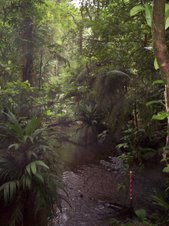
I sought to test this by comparing arthropod population densities and defenses in a moist tropical forest (La Selva, go figure) and a dry-seasonal forest (Palo Verde), both in Costa Rica. I also observed insectivorous birds and recorded various measures of foraging success & movement rates. I originally analyzed this data using univariate parametric and non-parametric statistics (t-tests, ANOVA, Chi-square, Kolmogorov-Smirnov) and also ran it through a multivariate MANOVA, but found few significant results.
I'm very curious to see if Bayesian analysis will produce similar results. I also have several references upon which I based my hypotheses from which I can draw data for prior distributions, and I want to test the influence of several different informative and non-informative priors.
Showing posts with label Independent Project. Show all posts
Showing posts with label Independent Project. Show all posts
Friday, March 2, 2007

Wednesday, January 24, 2007
Independent Project ideas
I've been kicking a few ideas around for the independent project. Ideally, I was hoping to be able to analyze some of my own data. However, the data I collected last summer has already been analyzed as fully as I believe it could/should be. I'll be collecting more data over spring break, but I'm concerned that will be too late to begin the project.
Instead, I think I'll work with the niche breadth and complementarity dataset of Tom's, which I began working with last fall but was put on hold while we waited for some samples from Tom's former advisor. The dataset includes information on foraging height, arthropod species consumed, habitat, maneuvers used, substrate, et al. for about a dozen species of rainforest-dwelling insectivorous birds in Costa Rica (mostly in or near La Selva). We're testing to see whether there is an inverse relationship between habitat and food specialization in this guild resulting in niche diffferentiation. That is, we expect that species that consume similar diets will be separated spacially (by habitat, height, etc.) and vice versa. We intend to combine this with a phylogenetic analysis (perhaps phylogenetic independent contrasts? need to look into this further) to identify which differentiation (habitat vs. food) developed first - the prediction is that similar species will differentiate spatially fairly rapidly, while specialized food habits will take longer to involve.
We plan to test this using Mantel tests, which can be run using an add-on package for R which you can download from CRAN. I haven't looked into this yet, but had good success with the VEGAN package which I used last summer, and I expect this will be similar.
Instead, I think I'll work with the niche breadth and complementarity dataset of Tom's, which I began working with last fall but was put on hold while we waited for some samples from Tom's former advisor. The dataset includes information on foraging height, arthropod species consumed, habitat, maneuvers used, substrate, et al. for about a dozen species of rainforest-dwelling insectivorous birds in Costa Rica (mostly in or near La Selva). We're testing to see whether there is an inverse relationship between habitat and food specialization in this guild resulting in niche diffferentiation. That is, we expect that species that consume similar diets will be separated spacially (by habitat, height, etc.) and vice versa. We intend to combine this with a phylogenetic analysis (perhaps phylogenetic independent contrasts? need to look into this further) to identify which differentiation (habitat vs. food) developed first - the prediction is that similar species will differentiate spatially fairly rapidly, while specialized food habits will take longer to involve.
We plan to test this using Mantel tests, which can be run using an add-on package for R which you can download from CRAN. I haven't looked into this yet, but had good success with the VEGAN package which I used last summer, and I expect this will be similar.
Subscribe to:
Posts (Atom)