...ok, so it wasn't snow exactly, but as I'm sure you all noticed it was bloody cold last weekend! I woke up Sunday morning - on the Florida coast near Pensacola, mind you - to find ice on the windshield and sleet collected on the cycad plants. Ice - in Florida - in April!!! I tried to find historical weather data for Pensacola to see if I could calculate the probability of temperatures <40 in the first week of April, but couldn't find any free data. I imagine the probability's pretty low, though.
I'm slowly poring through the Bayesian papers and book. It's quite complicated - both theoretically and practically - but we've had a local Bayesian expert, Chuck Bell, speaking to our Phylogenetics class, which has been helpful. He uses Bayesian stats in a different manner (specifically for phylogenetic tree selection, which uses somewhat different techniques and software programs than ecological analysis), but his lectures have been a huge help in understanding the theory behind the techniques (and learning how to read all that Greek code - ok, Latin, but it looks like Greek to me!).
Showing posts with label bayesian. Show all posts
Showing posts with label bayesian. Show all posts
Thursday, April 12, 2007

Thursday, March 29, 2007
This and that...
I'm finally back, after a several-week blogging hiatus. The last few weeks have been incredibly hectic, between working out the final details of my experimental design, writing 3 proposals, and generally preparing for my field season which will begin May 7 (getting permits, equipment, etc etc). Oh yeah, then I took a few days off to go to Big Bend NP in Texas - a much-needed break in an incredibly beautiful spot!!!
I'm beginning the process of learning Bayesian analysis techniques. I contacted Jackie Mohan, a candidate for the EBIO dept's Global Change position, regarding good intro texts, and she made several recommendations. Several of the papers she recommended were helpful and provided a good introduction, especially "Alternatives to statistical hypothesis testing in ecology: A guide to self teaching" by Hobbs and Hilborn (Ecological Applications 16(1): 5-19; 2006).
I also purchased several Bayesian Analysis textbooks (thank goodness for cheap used textbook websites - how did I ever manage to get through undergrad without the internet?!?) and am starting to work through them. Interestingly, we've been discussing Bayesian techniques quite a bit in my Phylogenetics class as well, and we even have an "expert" in the use of likelihood and Bayesian techniques for phylogenetic studies speaking to our class next week.
I'm beginning the process of learning Bayesian analysis techniques. I contacted Jackie Mohan, a candidate for the EBIO dept's Global Change position, regarding good intro texts, and she made several recommendations. Several of the papers she recommended were helpful and provided a good introduction, especially "Alternatives to statistical hypothesis testing in ecology: A guide to self teaching" by Hobbs and Hilborn (Ecological Applications 16(1): 5-19; 2006).
I also purchased several Bayesian Analysis textbooks (thank goodness for cheap used textbook websites - how did I ever manage to get through undergrad without the internet?!?) and am starting to work through them. Interestingly, we've been discussing Bayesian techniques quite a bit in my Phylogenetics class as well, and we even have an "expert" in the use of likelihood and Bayesian techniques for phylogenetic studies speaking to our class next week.
Friday, March 2, 2007
Independent Project
After speaking with Mike Guill re: Bayesian stats earlier this week, I've decided to change my independent project. I'm really interested in learning more about Bayesian analysis - I like the philosophical concepts behind the techniques (directly testing the hypothesis rather than the data, using prior information to come to a conclusion). I'm curious to see for myself how the analysis works (I can't really fully understand a technique like this until I've done it myself), and just how influential informative priors are on the outcomes. So, rather than analyze Tom's dataset of niche breadths for competitive exclusion, I'm going to revisit an old dataset of mine comparing arthropod abundance and defenses and avian insectivore foraging success in two Costa Rican forests.
This data was collected to test one component of an avian life-history theory which my lab has been working on. Birds - like many other organisms - have a distinct latitudinal gradient in demographic rates (most notably clutch size, but also survival et al.) wherein tropical birds have "slow" life-histories (low reproduction, high survival, low metabolic rates) and temperate birds have "fast" life-histories (high reproduction, low survival, high metabolic rates). Hypotheses have been proposed to explain this since the early 1900s, but none fully explain the observed patterns.
We suspect that food limitation is at the root of this gradient. Specifically, we cite references showing that tropical insectivorous birds face strong food limitation - contrary to popular belief - due to the low seasonality (lack of a seasonal "flush" of resources), low population densities of arthropods, and strong predator pressure (due to many species of insectivorous birds feeding on arthropod prey) leading to development of strong anti-predator defenses (physical, chemical, and behavioral) by arthropods. These forces should be strongest in so-called "perhumid" moist tropical rainforests with limited seasonality, moderate in dry-seasonal tropical forests, and weakest in temperate areas.
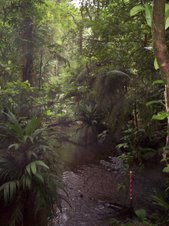
I sought to test this by comparing arthropod population densities and defenses in a moist tropical forest (La Selva, go figure) and a dry-seasonal forest (Palo Verde), both in Costa Rica. I also observed insectivorous birds and recorded various measures of foraging success & movement rates. I originally analyzed this data using univariate parametric and non-parametric statistics (t-tests, ANOVA, Chi-square, Kolmogorov-Smirnov) and also ran it through a multivariate MANOVA, but found few significant results.
I'm very curious to see if Bayesian analysis will produce similar results. I also have several references upon which I based my hypotheses from which I can draw data for prior distributions, and I want to test the influence of several different informative and non-informative priors.
This data was collected to test one component of an avian life-history theory which my lab has been working on. Birds - like many other organisms - have a distinct latitudinal gradient in demographic rates (most notably clutch size, but also survival et al.) wherein tropical birds have "slow" life-histories (low reproduction, high survival, low metabolic rates) and temperate birds have "fast" life-histories (high reproduction, low survival, high metabolic rates). Hypotheses have been proposed to explain this since the early 1900s, but none fully explain the observed patterns.
We suspect that food limitation is at the root of this gradient. Specifically, we cite references showing that tropical insectivorous birds face strong food limitation - contrary to popular belief - due to the low seasonality (lack of a seasonal "flush" of resources), low population densities of arthropods, and strong predator pressure (due to many species of insectivorous birds feeding on arthropod prey) leading to development of strong anti-predator defenses (physical, chemical, and behavioral) by arthropods. These forces should be strongest in so-called "perhumid" moist tropical rainforests with limited seasonality, moderate in dry-seasonal tropical forests, and weakest in temperate areas.
I sought to test this by comparing arthropod population densities and defenses in a moist tropical forest (La Selva, go figure) and a dry-seasonal forest (Palo Verde), both in Costa Rica. I also observed insectivorous birds and recorded various measures of foraging success & movement rates. I originally analyzed this data using univariate parametric and non-parametric statistics (t-tests, ANOVA, Chi-square, Kolmogorov-Smirnov) and also ran it through a multivariate MANOVA, but found few significant results.
I'm very curious to see if Bayesian analysis will produce similar results. I also have several references upon which I based my hypotheses from which I can draw data for prior distributions, and I want to test the influence of several different informative and non-informative priors.
Monday, February 5, 2007
G&E Ch. 3
This chapter discussed summary stats - mean, sd, se, cv, median, mode, and all that jazz. Mostly stuff we've discussed in many classes before - and in Ch. 2 of JV - but they made a few interesting points. The descriptions of the different kinds of means (arithmetic vs. geometric vs. harmonic) and when they're used was interesting - we used geo. means in a pop. ecology/analysis class I took a couple years ago, but I never really understood why. I also liked the description of degrees of freedom - finally, it makes sense. That's what I like about this book so far (as I've said before) - they give good, easy-to-understand descriptions of basic things that, generally, are assumed to be understood (yet rarely/never explained) in other stats books.
Then later in the chapter they bring up Bayesian stats again a couple times, but never follow up... Why don't we have a Bayesian stats class here? I'm not even aware of any current faculty who have much experience with Bayesian stats, with the exception of their use in systematics (correct me if I'm wrong)...I'll have to read up, because it seems that they're becoming more common...
Then later in the chapter they bring up Bayesian stats again a couple times, but never follow up... Why don't we have a Bayesian stats class here? I'm not even aware of any current faculty who have much experience with Bayesian stats, with the exception of their use in systematics (correct me if I'm wrong)...I'll have to read up, because it seems that they're becoming more common...
Subscribe to:
Posts (Atom)